FreightFx: bringing freight to your AI
If you work in logistics and you've seen what AI can do in other sectors, used it in your personal life, and wondered why you aren't getting these same benefits at work, this article is for you.
Rolando De La Torre ·
What is FreightFx?
Suppose you work in freight and you'd like to use your favorite AI (e.g. Claude) for help with your daily work: quoting, tracking, getting information from PDFs into your systems. As is, you can't. To make that happen, you'd need to build notoriously complex technical infrastructure and tools that let an AI work between your system and carrier systems. Or you could rent that infrastructure from a company that would likely require you to use their AI.
FreightFx exists to bring freight to your AI in what I think is the easiest way possible. You can see it at freightfx.ai.
Setup looks like this: just add the connector and enter your credentials.
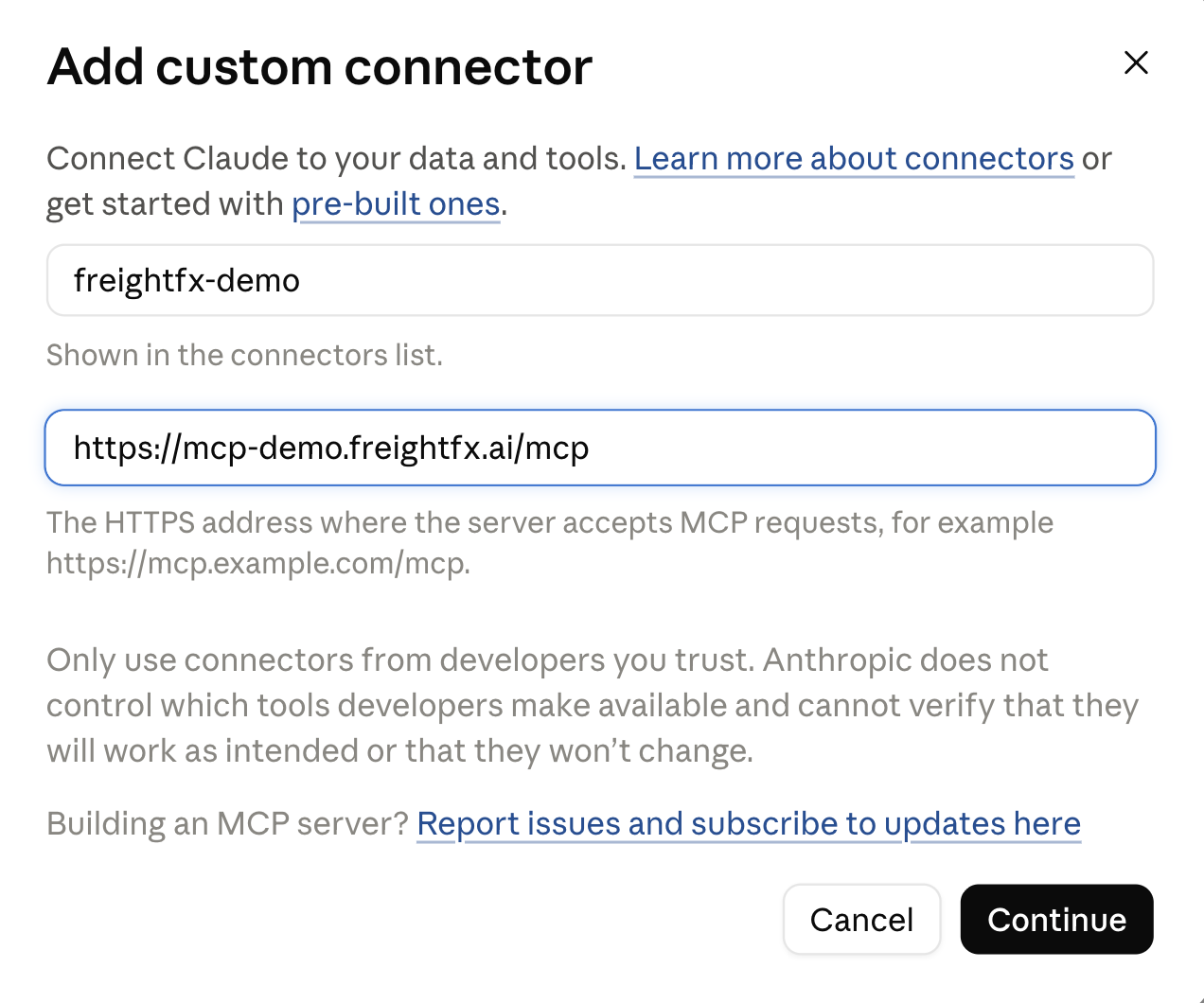
Once you do that, here's what it looks like to turn a quote request from an email to an actual quote:
As another example, you just ask Claude for statuses.
These are just a few functions demonstrated. AI is great at working with images and PDFs. That ability, combined with the ability to work directly in your systems, becomes very useful.
Now you can keep building handy AI-assisted workflows without having to build out the freight infrastructure piece yourself. Think freight-equipped agents from Bedrock, Agent Platform, and others, unleashed.
Is this a TMS? No. It provides tools that integrate your existing AI with a TMS. Though it's worth noting: FreightFx makes it possible to execute TMS functions outside of the TMS.
Am I building my own AI agents? No. Anthropic, Google, OpenAI, and others are much better at that, so I just equip their agents with the functions they don't have. You get the best of their development and features, plus the ability to do your freight work.
Note for more technical readers: I'm building the carrier connectivity infrastructure by teaching Claude to prep, build, and audit the most tedious parts. Yes, no more manually grinding through carrier APIs.
What does the name FreightFx mean?
The core of this project is making freight functions available to AI. The notation f(x) communicates that we're dealing with functions, but doesn't really work in a company or project name. Fx seemed to work best.
Backstory
About two years ago, I flew to Austin to run a few potentially crazy ideas by my good friend and experienced entrepreneur, Ben. This was one of them. I walked him through a few sketches and some early market research, and his response was sensible and straightforward: "I don't understand anything about freight, but let's talk to people who do."
So that's what we did.
We spoke to experts who had either worked as freight executives, financed freight projects, or both. The logic being that they'd know the landscape and could tell us if this was worth attempting, or if they had enough evidence to say we were crazy, or that someone was already doing exactly this. The consensus was that we weren't crazy, and the encouragement was enough to inspire me to start building the thing more seriously, to start showing instead of telling.
The first person who saw the early prototype recommended I apply to OnwardFX in Bentonville. This was sound advice. Before OnwardFX, I had never pitched VCs, and knew relatively little about how the institutional investing world works. After Onward, I had pitched multiple VCs one-on-one, taken a crash course on how it all works from a VC co-founder, and got to meet first hand other founders from many different sectors and hear what they were working on. You can't replace the experience of doing this in person by reading about it.
Unsolicited plug: whether you take a deal or not, I would highly recommend anybody serious about working on a startup get to Bentonville for OnwardFX or an event like it.
After this, I had to take the information on board and make decisions. Also, I needed a break.
What's Next
The connector pipeline is what decides whether this scales. Three carriers are integrated today: SAIA, R+L Carriers, and Estes Express, with XPO next. Each one goes faster than the last, because corrections discovered during an integration are written back into the service recipe instead of staying in my head.
The other half is the outbound direction. TMF is bidirectional: carriers in, TMS out. An adapter for Rose Rocket pushes orders into a freight brokerage dispatcher pilot, deliberately held in draft state rather than auto-dispatching while the pilot proves itself.
What's left is volume. The concept is vetted and the infrastructure works. The open question is how quickly the pipeline can absorb carriers at scale, and that's where the work goes next.